Showing posts with label fertilizer. Show all posts

Saturday, September 22, 2012

Why use "lasagna" no till gardening?

I have already talked all about how wonderful compost is for your garden.  For some people, including myself, there is just not enoughroom in your yard to have enough compost piles to feed your wholegarden.  So why not just turn your whole garden into a compost pile?
Lasagna gardening or a no till garden does just that.  You build up your garden with the same layers of browns and greens that you would in acompost pile and just leave it there.  When done well, you can plant your garden right into these piles of compost with little further effort.  You don't need to till because the materials will compost and turn into a nice, soft bed for you to plant your garden in.  You don'tneed to fertilize because your garden is going to be built out of fertilizer.  You don't need to weed as much because the thick layers will block the weeds from growing where they would normally grow.  You don't need as much water because the organic composting materials hold much more water than standard garden soil and the water is there waiting for your plants to drink it up.  The layers you add on to the garden may even prevent some of the diseases and pest you have had in the past from being able to return to your garden for another year.  
I think this coming year I will dive right in and set up my garden this way.  Starting when I do my fall clean up.  The hope is that I walk out to my garden in the spring and throw the plants in the ground and they are already fed and watered for the majority of the summer.  That and I won't have to do much weeding.  We will see how this works out.

Saturday, September 8, 2012

How to care for your compost pile

Once your pile is built, the only maintenance it needs is water and aeration.  The bacteria you have working for you are just like most other creatures on earth.  They need water and they need oxygen.  If the pile dries up, the decomposition will just slow way down.  If there is no oxygen, then the anaerobic bacteria will get to work.  These are the bacteria that don't need the oxygen to work.  If this is what you have going on, your pile will smell really bad.  This is not what you ideally want to have going on.
If you chose a good location, you may not have to water except on the really hot spells.  Compost is good at holding water so if it rains often enough, the pile will hold an adequate water supply and won't need much help.
If you keep the size of your pile about a 3 foot diameter, that helps greatly with the aeration of the pile.  If it gets much bigger, the surface area to pile ratio is greatly reduced and there is less available oxygen for your pile.  Either way you will need to aerate your pile to some extent.  The smaller piles are less material to move around and are therefore easier to aerate.  The most common method of aeration is a pitchfork.  Dig in and throw your pile around.  Try to get all of the drier outer material closer to the inside so it can start breaking down too.  They do make fancy tools to aerate your compost, but I have found that those work well for a bucket composter or for the edges only of your pile.  They don't get the heavier innards of your pile very well.  A good old fashioned pitchfork will do the trick perfectly.

Thursday, August 30, 2012

Worm bin or not?

It seems to me that a worm bin is one of those things that you are supposed to have when you are living on any type of organic farm.  I built one a couple years ago and I'm not really sure if I want to keep it or  not.  It seems to me that it is extra work and extra space that is just not necessary.  I do get good castings and good compost tea, but in small enough quantities that I can't really do much with it.  I could build a much larger bin, but I'm not sure I could then feed it well enough.  There are only three of us in the house right now so we really don't produce much scraps.  Every time I feed the worms, I have to put all new bedding down which does take up some time as well.  I think that throwing all my kitchen waste into my kitchen scrap composter is far less work and I seem to get just as good fertilizer out of it.  I also get it in much larger quantities when I go to use it because the can is much larger.  If you lived in a place where you didn't really have much yard space, a small worm bin could be ideal, but I think I'm going to just stick to a bigger, "lazier" type composter for my house.  Half of the idea of permaculture seems to be less work for more gain anyways.  Set things up so that they are efficient and mostly function on their own.  The worm bin doesn't do that for me.

Tuesday, August 7, 2012

Why compost and not chemical fertilizer?

If you have read all of the previous posts on composting (why, what' happening, what goes in, and where to put it), you may be wondering why you should compost and not just use fertilizer.  Have you ever tasted the difference between a tomato you picked off the vine and ate right away verses a tomato you bought at your local supermart?  That is probably the difference the plants "taste" between compost and chemical fertilizer.  Compost is fresh and alive, teeming with life.  It smells good and feels light and fluffy.  It holds on to water and feeds it back to plants that are so happily living in it.  It becomes part of the soil and bring nutrients and life to anything that grows in it.  Chemical fertilizer is stale and dead, having nothing alive about it.  You can't smell it or touch it with bare hands because it is poisonous to people.  It washes away when it rains and flows down to local lakes and streams and poisons them.  You don't notice it's poison because you think it's helping your plants grow big and healthy.  But what is really doing is stripping the soil of all its nutrients so that you have to buy and apply more and more every year.  When you apply compost, it  works in to the soil and just gets better and better.  You should still add more every year, but if you don't, there is still good stuff left over from before.  If you use chemical fertilizers, there is actually less than what your soil started with.  Nothing left from the year before, it all washed away rather than incorporating into the soil.  In addition, if you throw mulch, like fall leaves, on top of your compost, that will also turn to compost giving you the benefit of both the mulch and later the compost.  Happy plants and happy gardeners!

Tuesday, July 24, 2012

Kitchen scrap composter

This is a picture of my kitchen scrap composter.  They do make expensive, fancy versions that are probably nicer to look at, but mine only cost about ten dollars.  I chose a garbage can with wheels so that I could move it and a locking lid to keep critters out of it.  Next I drilled holes all around the sides and bottom for aeration.  That's it.  All finished.  When you start filling it up with kitchen scraps, it is a good idea to remember to brown vs green ratio.  I throw newspaper or cardboard in with the scraps to try to maintain the mixture.  By adding just kitchen scraps, you end up with a stinky wet sludge pile that becomes a solid mass that can't compost, so don't forget the browns.  Every now and then you should give your compost a good mix.  I tip my garbage can on its side and roll it around a little bit.  Be sure the lid is locked on tight before you get to rolling it or you may have quite a mess on your feet.  Not everyone may feel the need to compost kitchen scraps separately.  I do this because it keeps the critters away and because I can't get to my compost pile when it's snowing.  During the winter, when the compost freezes, I had the garbage can rolled right up next to the door for easy adding of my scraps.  It won't smell or anything because it is frozen solid.  Just be sure to move it away from the door as soon as things start thawing.

Tuesday, July 17, 2012

Structure for your compost pile


There must be a hundred different structures you can build to house your compost pile.  You can get from very simple like a pile with no structure all the way to a three bin rotation system or a large barrel mixer.  Some people go for the expensive fancy systems because they are nicer to look at or because they don't want to get too dirty.  Others don't care what they look like and even like to play in the dirt, so they go for the simpler no structure or simple structure type of a pile.  Sometimes, you need something more complicated if you have a lot that needs to be composted.  Currently, I have 2 composter types at my house.  A pile of leaves that sometimes has a wire cage around it and a garbage can with holes drilled into it for kitchen scraps.  Very simple, easy to build and easy to manage.
I like the pile because as I work I can just throw everything right there into the pile with no effort, rhyme or reason.  I do have to go back and mix it up as it composts, but not too much.  The wire cage helps to contain the pile somewhat so that it doesn't go everywhere or blow away.  It goes up when there starts to be too many leaves to keep in place in the fall.  When the cage is in my way, I just open it way up or take it down.  This usually means that I am mixing the pile or it's time to throw it on the garden.  Just about every time I have taken the cage down, it goes up in a totally new spot.  That is just one more reason why I like it being so simple.  I can change my mind as to where the best spot for it is whenever I need to.

Tuesday, July 10, 2012

What to put in a compost pile


Now that you have a spot set up for your compost pile, what do you put in it?  You need a good mixture of green and brown materials.  Green materials are things like grass clippings and fruit and vegetable scraps.  Brown materials are leaves and papers.  This combination is again to support the bacteria you are trying to get to work for you.  They need certain nutrients that are available from the different materials.  Carbon is in the browns and the greens are for nitrogen.  The suggested ratio is 25 parts carbon to one part nitrogen.  If you have too much nitrogen, don't worry, it will just smell a little funny.  If you have too much carbon, the pile won't break down very well.  You can always add other things to your pile like wood ash, seaweed, or shells if you need other nutrients for your soil but these are the basics.

Monday, July 2, 2012

Where to put your compost pile

The first step in composting is to choose a good spot.  The bacteria living in your pile that are breaking it down for you need warmth and moisture to do their jobs.  Therefore, choose a location where you get a little of both.  If you put the pile in the middle of a sunny field, it will likely dry out, kill the bacteria, and not compost quickly.  It will also likely get too much rain and that can kill the bacteria too.  Don't put it under total cover either.  You want it to get some sun to warm it up and some water from the rain so you don't have to water it yourself.  My pile is at the edge of the tree cover in my yard, right at the border of my garden.  That way it is in the sun part of the day but can still get rained on.  Another option is to put it anywhere you have some room in the sun, water it when it gets dry, and cover it with a tarp to retain the moisture.  I always go for the choice with the least effort and I think that tarps are ugly.  One other consideration for location is effort to get things to and from the pile.  I mentioned that my pile was at the edge of my garden.  This makes for less work in the spring when I am the busiest.  I have to walk further in the fall when I am raking leaves, but that time of the year isn't as busy so I don't mind.
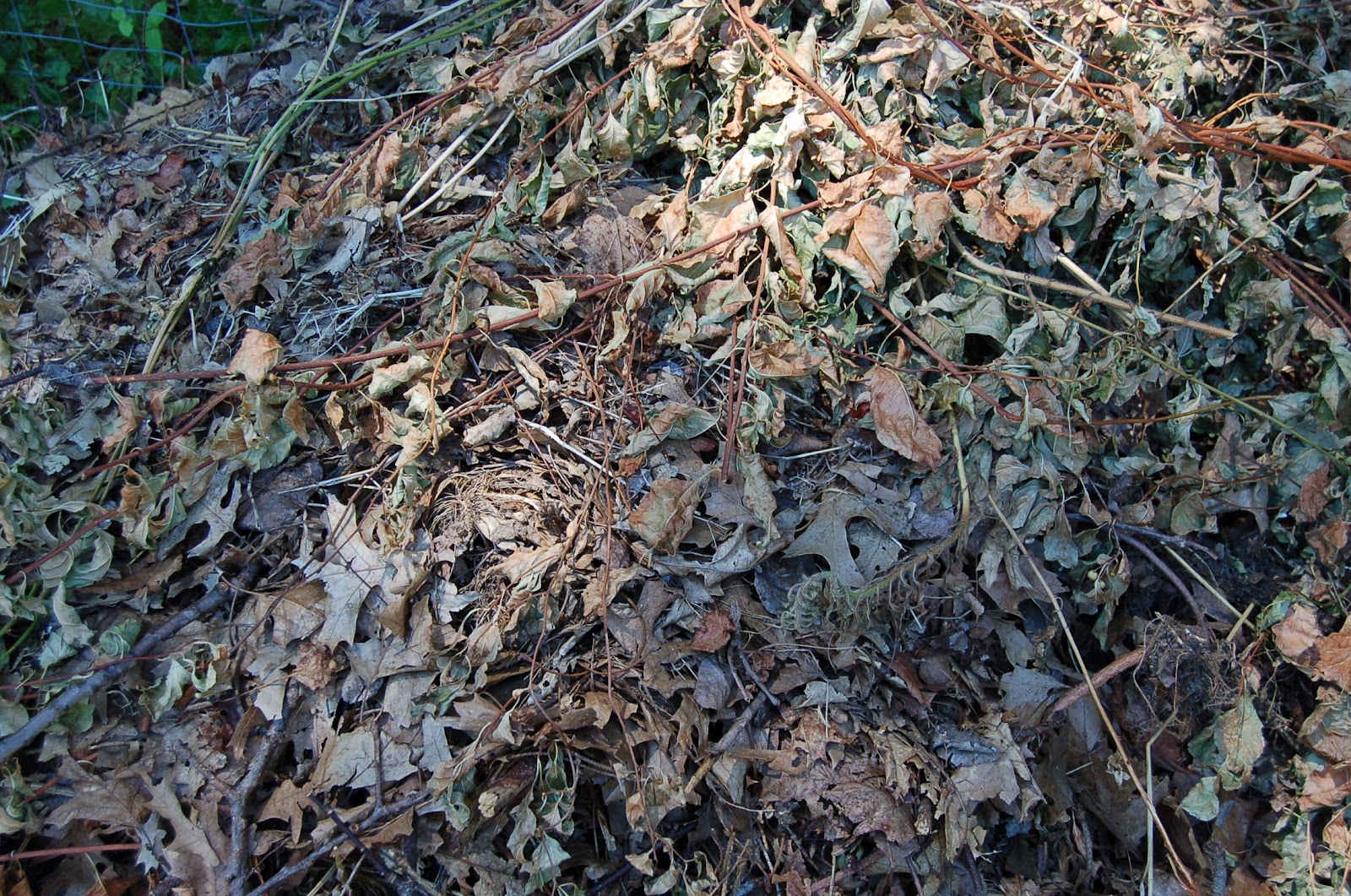
If you notice, the old compost pile is in the middle of where you would find all of the fallen leaves.  This made sense when I was raking leaves, but then when it came time to move the finished compost, I realized what a pain it was to move all that heavy compost across the yard.  There was a second compost pile under the pine trees, but that was a mistake as well.  Whenever I went to the pile I was attacked by hundreds of hungry mosquitos.  So now the pile is out at the edge of the tree line where I hope it will be able to stay.

Thursday, June 28, 2012

Hugelkultur mounds

The perfect way to fertilize a tree or bush is a hugelkultur mound.  This will provide food for years with only a little effort  in the beginning.  It retains water so you don't need to provide supplemental, just rain water should do.  It gets nice and warm so that if you are planting trees or bushes that should be in a warmer climate, they have a much better chance of surviving.
 So what is a hugelkultur mound, now that I know I want one?  Basically it is a pile of rooting wood around your tree or bush that is covered with dirt.  It rots and breaks down just like a compost pile which provides nutrients, the spongy water retaining texture and the heating up.
It is very easy to set one up.  When I planted the bush here in the picture, I just set it up around the planting.   I started out by digging an extra wide hole with the deep spot in the deep spot in the middle for the bush to
go.  I put a handful of leaves into the hole and put the bush on top of that.  Then I placed four large logs each on one side of the bush in the hole.  Then I filled in the spaces with large and then small sticks trying to fill in most of the gaps.  Over the top of that, I put a couple handfuls of leaves over all the wood around the base of the plant.  Cover the leaves with the dirt you dug out of the hole.  I did a lot of stomping on the dirt all around the plant because I'm sure that it is going to pack down at some
point.  I did water it some, but it is supposed to rain tomorrow, so I didn't go too crazy.  I assume that when it rains, it will all fall in and I will have to top it off.  Either way, this bush should do fantastic as soon as it settles in. The logs I used were already started rotting, so I don't think it will be long before that bush can begin to benefit from it.

Tuesday, June 26, 2012

What is happening in a compost pile?

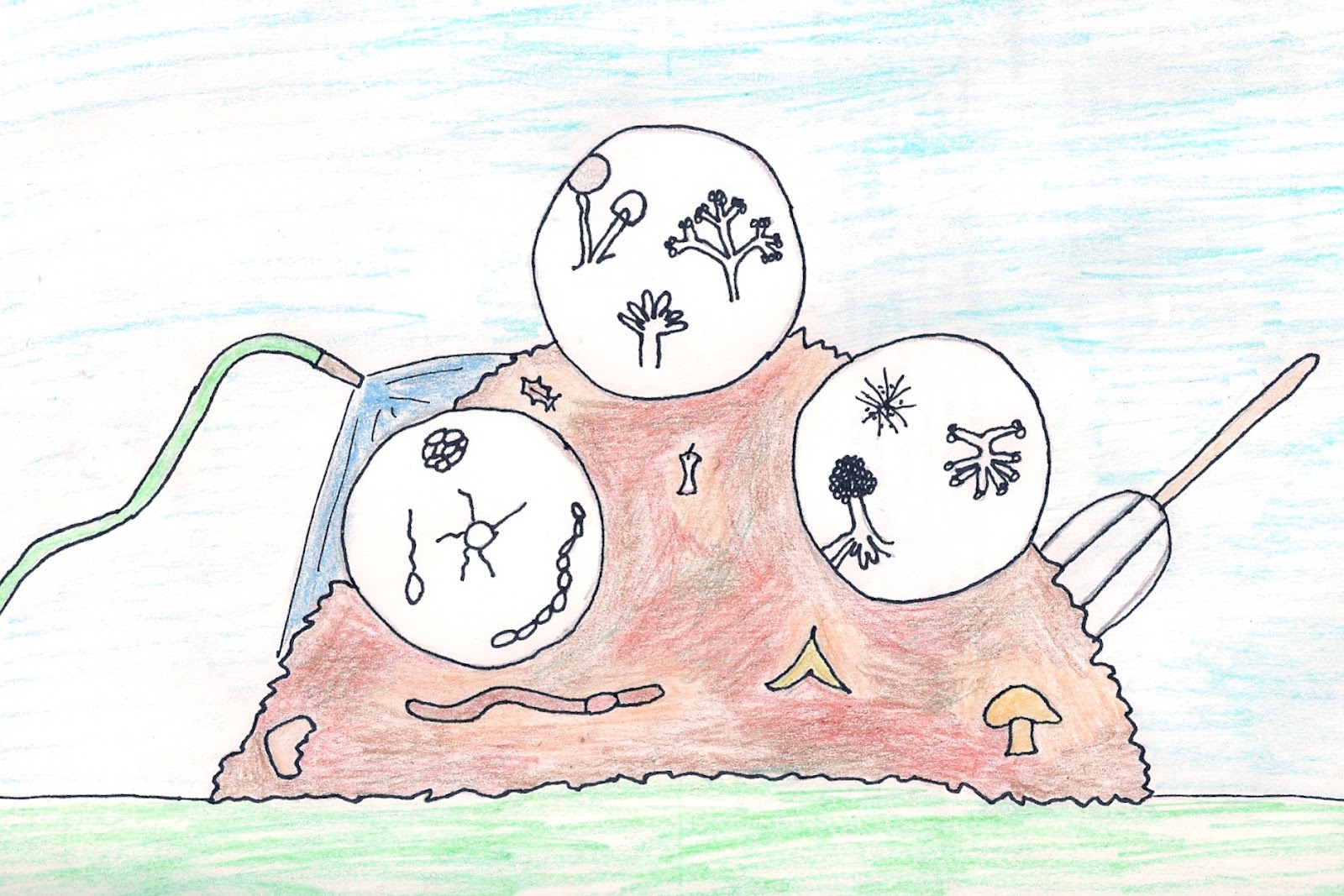
Now that you know that you want to have a compost pile, what is going on in that pile that leaves you with such great plant food?  When you set up a compost pile in your yard what you are really doing is building a giant buffet for bacteria, microbes, fungus, mold, worms, and other tiny creatures. These creatures are naturally present everywhere, but when given the proper conditions, like in a compost pile, they run wild. They each have their own favorite meals, and so everything gets eaten.
Bacteria are the main workhorses int he compost pile.  They take in oxygen and use it to breakdown the organic materials in the pile.  As a byproduct, they create carbon dioxide and heat.  The heat created can get to be up to 140 degrees.  This will attract heat loving microbes to do their part of the decomposing process.  Once the microbes are done, the  worms come through and eat whats left of the organic matter leaving you with nutrient rich worm poop.  

Thursday, June 21, 2012

Why compost for my garden?


If you were to walk out into the woods, brush the leaves away from the ground and take a good look at the soil, what would you see? You would see natural, rich, healthy soil that is perfect for growth. The leaves and twigs fall from the trees, lay around for a while on the ground, and eventually breakdown for the new plants to grow in. This is a perfect medium for healthy plants. Compost is the same thing, except we can customize it and speed up the process depending on our soil needs. We rake up our leaves and throw them into a pile along with food scraps and whatever else we may have. We water the pile and mix it up so that it breaks down quicker. We can add things like seaweed, wood ash, oyster shells, or anything else we may need to make the soil we have into the soil we want to have. 
This broken down organic matter does many things for our plants. It provides essential nutrients like nitrogen, phosphorus, potassium, calcium, sulfur and micronutrients that plants need to grow. It adds texture to the soil so that there can be adequate air exchange and water retaining and draining abilities. It is much less compact and dense than standard dirt allowing for roots to move around more effectively. The composting process causes the soil to heat up and therefore kill pathogens and some weed seeds. Compost laid out in your garden can also prevent weeds from coming up and prevent erosion similar to how mulch works. Is that enough reason for you yet?
New sprouts in compost

Tuesday, June 19, 2012

Oyster shell fertilizer


The shells of oysters and many other sea creatures, like lobsters, have shells made up of calcium carbonate.  Therefore, if you eat a lot of seafood and are throwing out the shells, you are wasting valuable garden fertilizers.  I brought home a bag of oyster shells last night to add to my compost pile.  What I am going to do is to first wash them out so that the local critters don't take an interest.  Then I'll sandwich them between a couple old rags and smash the shells into little bits.  I smash them because a whole shell is a lot to break down in a compost and it would take forever.  Next I can just throw them right into the compost pile.  You can do this with many kinds of sea shells and things like eggs as well.  They will all add calcium carbonate to your soil.  Calcium carbonate is basically what lime is just in case you didn't know that already.

Thursday, June 14, 2012

Wood ash fertilizer

After cutting down a few trees the other day, we had a large pile of wood.  So we spent the evening sitting around our fire pit enjoying the days work.  This is what was left of our trees the next day:
Lovely organic fertilizer.  Wood ash is an excellent fertilizer for your garden.  It adds potassium and raises the pH of the soil.  If your pH is low, then you can sprinkle the ash over the soil before you plant for the season. If you do not need to raise the pH, then just add the ash to your compost pile to reap the benefits.  When using ash to fertilize your garden be sure that what you are burning is safe for your plants.  Pressure treated wood is full of chemicals that can kill your plants, and is also unsafe for you to be breathing as it burns.  Black walnut trees are full of juglones which can prevent grow of many plants.  And whatever you do don't burn things like poison ivy.  It could really ruin your day.

click for more information