Showing posts with label bugs. Show all posts

Sunday, August 19, 2012

My flower garden: Marigolds


Marigolds are one of those flowers that has so many reasons to plant it.  It is an excellent companion flower all over your vegetable garden.
They are cheap flowers to buy and very easy t grow and maintain.  I am not good with flowers at all.  I kill them most of the time.  The only flowers I can grow from seed and get to survive are marigolds and nasturtiums.
There are some types of marigolds that are edible.  Therefore you can grow them and add them to a salad to make it pretty.  Some people also use them to make things like vinaigrette or even wine.  I have yet to taste one myself.
Marigolds grow from spring to fall.  They add color and beauty to your garden for until the frost finally kills them off.  This also means that you are attracting bees and butterflies to your garden for three seasons with just one type of flower.
The reason I plant marigolds in my garden is that they can be used to deter many types of problematic insects like tomato hornworm, Mexican bean beetle, nematodes, thrips, whiteflies, and squash bugs.
There are many types of flowers you can grow to do the things that I have listed above.  One of the more important concepts to keep in mind when setting up something like a permaculture homestead is that many things can have many different purposes.  Why do many things that each only serve one function when you can do one thing that can serve many functions?

Tuesday, August 14, 2012

Zuchetta (trombino) progress


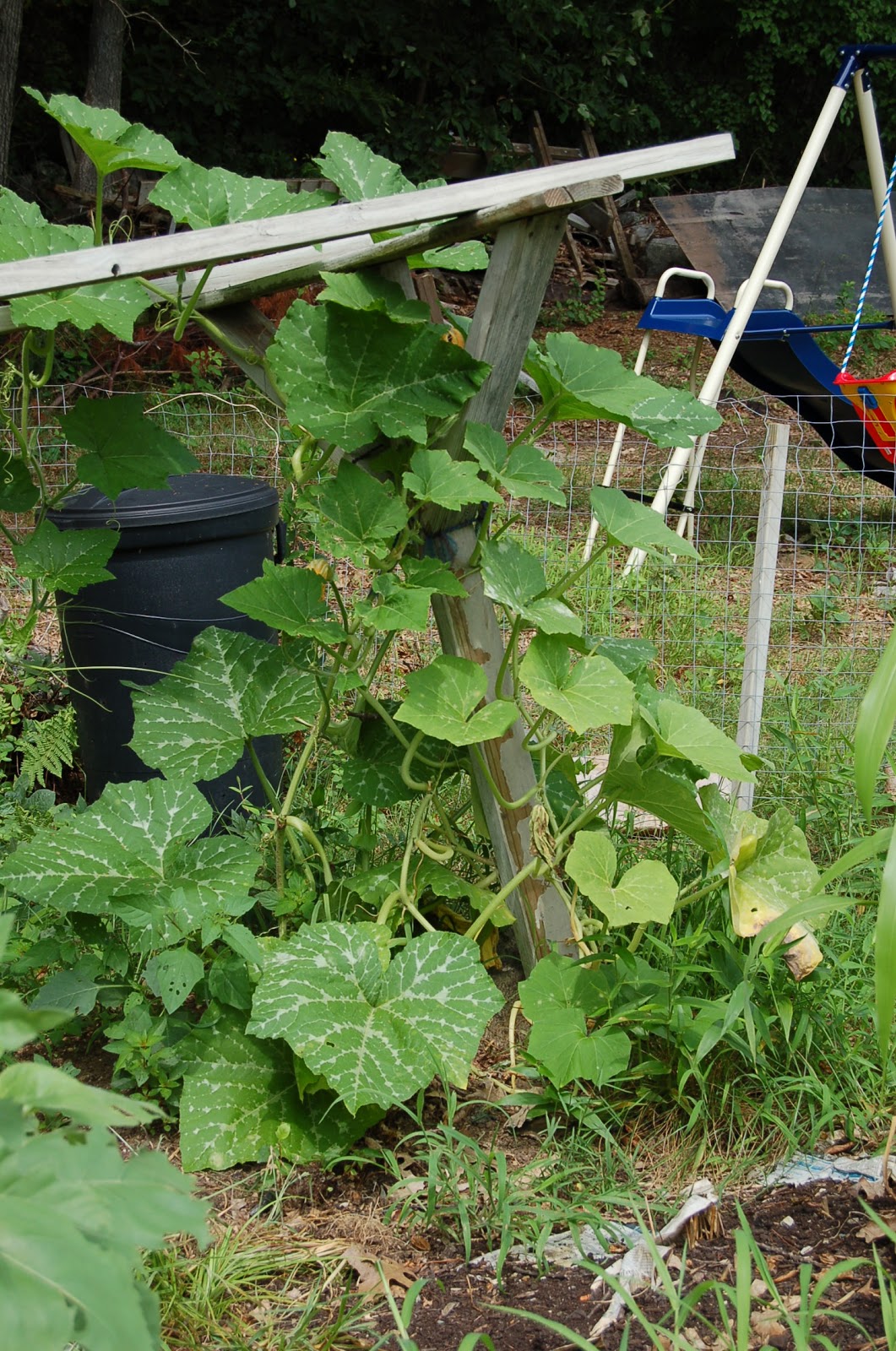
The zuchetta have finally started growing up to speed.  They did start off slowly, as I read they would, and now they are going crazy.  I have had to go out and wrap them around the trellis a time or two and they don't really seem to like it.  They don't want to stay there and there are root buds all over the place.  I did a little more reading, and it turns out that if you let them grow on the ground, they will be more productive.  I decided that I would let the vine at the middle of the trellis drop down to the ground and see what happens then.  I had seen quite a few 
fruits starting at one point, but I can't seem to find them anymore.  I'm not really sure why, but I am getting a few large fruits so I'm not too worried.  I will be going out to give the squash some compost this week, so maybe that will help to get me some more fruits.
I have been inspecting the plants almost daily looking for the vine borer damage that I am hoping to avoid by growing the zuchetta.  I have found a couple of suspicious spots, but upon further inspection can find no borers.  There are a couple yellowing leaves at the bottom, but the stem of the plant seems untouched.  A couple of the leaves even had that vine borer sawdust type look that I have seen so many times before but the spots aren't where I would expect them to be normally.  I have cut this part of the leaves open and found nothing.  So far it seems that the borers have not touched my zuchetta.  I'm not sure if this is just because they are zuchetta or because I got them in the ground a little late.  I have yet to notice any vine borer damage on my other squash, so who knows.  Either way, I get to have some squash from my garden this year.  Finally!!


Monday, August 6, 2012

Who is eating my tomatoes? Hornworms.

Ever gone out to your garden to find the tomato you were hoping to eat with a large bite taken out of it?  I have lost about eight tomatoes so far this year to this pest.  The large

bite is actually many little bites taken by a tomato horn worm.  They creep around on your tomato plants and eat just enough of your big beautiful tomato to cause it to fall off of the vine and rot on the ground before you can eat it.  They blend in fairly well so unless you are aware that they are around you may never see them.  I found this one while picking cherry tomatoes last night.  It was just sitting there not moving so I guess
that night time is a good time to find them.  I have also gone out in the morning to find them and if you are quiet enough you can actually hear them crunching away on your precious tomatoes.  If you look at the picture to the right, you can see the bites taken out of the unripe cherry tomato.  I snipped the branch off to dispose of this nasty thing before it got to anymore of my babies.  I also found one other horn worm
 tonight.  It, however, has succumbed to organic pest control. The little white things hanging from this worm are parasitic wasp eggs.  When the eggs hatch, they will eat the horn worm which means that the horn worm can no longer eat tomatoes. All you need to do to get the parasitic wasps to come to your garden and eat your caterpillars is to feed the adults.  They need flowers that their tiny little heads can get to.  Yarrow, mallow, parsley, angelica, and marigolds are all good potential food sources for parasitic wasps that I have in my garden.  Other good options are dill, cilantro, fennel, alyssum, and queen anne's lace.  If you find a hornworm that looks like this one, loaded with parasitic wasp eggs, leave it in your garden.  The one I found without any eggs I got rid of, but you want to keep this one.  Once the eggs hatch, they will turn to adult parasitic wasps and they do a much better job finding caterpillars than you ever could.  I doubt they can do too much more damage once they are infested.  I was very excited to find this in my garden. I would have been more excited to find ripe tomatoes I could eat, but at least the problem was being dealt with.

Sunday, August 5, 2012

My flower garden: Nasturtium

Nasturtiums can be grown for many reasons.  You can grow them because they are pretty flowers that are easy to grow.  You can grow them to eat both the flowers and the leaves.  I grow them because they are beneficial to the bug population that I want to have in my garden, or not so beneficial to the bug population I don't want.
There are many different types of nasturtiums you can grow in your garden.  Some grow like bushes, some grow like vines.  The colors range from yellow to red to shades of purple.  They grow well in not so good soil, so they can be planted anywhere there is full sun.  You pretty much just plant them and they grow.  I plant mine when I plant my beans and they bloom throughout the summer all over the garden.
Nasturtiums have a sort of peppery taste to them.  They are related to the cress family and are often added to salads both for their flavor and for their decorative qualities.  You can even use the seeds in pickling for an interesting taste.
I grow nasturtiums because they are known to ward off bad bugs.  An excellent form of organic pest control.  Cucumber beetles and squash vine borers dislike the peppery smell they emit.  Good places to plant them are among cucs, pumpkins, squash or anywhere you have room really.  Aphids, slugs and white cabbage butterflies like nasturtiums so they can be planted near other plants these bugs like so that they will go after the nasturtiums first.  I personally don't like this idea, but some people do use it with success.  Most flowers also attract pollinators to your garden.  Bees and butterflies are always a good thing to have around to help pollinate your crops.

Friday, July 20, 2012

My flower garden: Echinacea

Also called purple coneflower, echinacea is a beautiful and very useful flower to add to your garden.  I'm sure you have heard of taking echinacea as a vitamin for good immune health, but there are many other uses.  You don't need to go out and buy supplements either, just grow the flower in your own garden.
Echinacea is a wonderful flower to attract pollinators to your garden.  Butterflies and bees love the flower and I often find them all over mine out in the garden.  They attract many types of beneficial insects to your garden which are vital to maintaining an organic garden.  The seeds are also loved by finches, which eat the seeds and the bugs in your garden.
Echinacea root is loaded with antibacterial, antiviral, and antifungal properties.  Western societies use echinacea as an immune system stimulant while traditionally, echinacea is used to treat acne, blood poisoning, cuts and sores, and fever.  The leaves have some of these properties as well, but the greater concentration can be found in the roots.  The roots and leaves are both fairly simple to harvest and store so that you will have plenty you can put in storage to last you all year.

Wednesday, July 18, 2012

My vegetable garden: Zuchetta rampicante (trombino squash)

My garden has a horrible squash vine borer infestation.  I have not been able to grow and kind of squash or pumpkins in at least three years.  I have tried all the methods of getting rid of these pests, and none of them really did any good.  I split open vines and killed the borers one by one.  I started two rounds of squash using one as bait that I pulled out and burned with the intention of leaving the second batch in safety.  I tried row covers.  Then I gave up.  No squash at all last year.  This past winter I learned about zuchetta rampicante.  They are supposed to be naturally squash vine borer resistant.  This is plenty of reason to plant them for me, but they also have many other good reasons to plant them.
Zuchetta is a summer squash that vines and stores like a winter squash.  Rather than growing in a bush like most summer squashes, it is a vining plant grows up trellises and fences.  This may help in its vine borer resistance.  When you pick them, they have the soft skin of a summer squash, but the skin can harden so that they can be stored like a winter squash.  They apparently store so well that you can cut off one end and the cut piece will form a sort of seal so that the rest wont go bad.  The fruits can get up to three feet long and one plant can produce 20 squash.  I read that they taste similar to zucchini, but haven't been able to taste any just yet.  The vines themselves started fairly slow, but are beginning to take off quite quickly up my old grapevine arbor.  I did help them up it a little by tying them to it since there aren't any places for them to grab on the arbor.  I will post an update when I (hopefully) have some squash to show.

Tuesday, July 3, 2012

Balsamic vinegar fruit fly trap

I always seem to have a terrible fruit fly problem at this time of the year.  One day everything is fine and the next the kitchen is crawling with the pesky little things.  I had never been able to get rid of them until halfway through this year.  Balsamic
vinegar.  Put some into a little bowl and cover it with plastic wrap.  Poke a few holes into the top of the plastic big enough so that they can get in.  Then they can't get out.  My bowl filled up the very first day and the fruit fly count is dwindling.  Very exciting.

Thursday, May 17, 2012

Flower garden

This is my flower garden.  I know there aren't any flowers to speak of, but I am new at this flower gardening thing.  I never did feel the need to plant flowers.  What do I get out of flowers.  I  would much rather grow yummy fruits and vegetables.  But this is a special flower garden.  This garden is going to be full of perennial flowers that are put their to attract beneficial insects to my garden.  (Perennial flowers so they come back every year.)  Bees and butterflies help to pollinate my fruits and vegetables.  Since there aren't any of these yet, I need flowers like the Angelica in the pictures to attract these bugs so that they will hang out in my garden.  Come time for my garden to be pollinated, it will be full of helpers to do the job.

 Another kind of bug that these plants will attract are parasitic wasps.  They aren't the big wasps that you are used to, but little tiny ones that don't sting.  What they do is help to rid the garden of unwanted bugs.  Bugs like tomato horn worn can destroy my plants.  The parasitic wasps lay their eggs on the horn worm and when the eggs hatch, the babies eat the horn worn and the horn worm doesn't eat my tomatoes.  This is a much better option than nasty chemicals any day.
For more information try this link Beneficial Insects