Showing posts with label garden. Show all posts

Saturday, September 22, 2012

Why use "lasagna" no till gardening?

I have already talked all about how wonderful compost is for your garden.  For some people, including myself, there is just not enoughroom in your yard to have enough compost piles to feed your wholegarden.  So why not just turn your whole garden into a compost pile?
Lasagna gardening or a no till garden does just that.  You build up your garden with the same layers of browns and greens that you would in acompost pile and just leave it there.  When done well, you can plant your garden right into these piles of compost with little further effort.  You don't need to till because the materials will compost and turn into a nice, soft bed for you to plant your garden in.  You don'tneed to fertilize because your garden is going to be built out of fertilizer.  You don't need to weed as much because the thick layers will block the weeds from growing where they would normally grow.  You don't need as much water because the organic composting materials hold much more water than standard garden soil and the water is there waiting for your plants to drink it up.  The layers you add on to the garden may even prevent some of the diseases and pest you have had in the past from being able to return to your garden for another year.  
I think this coming year I will dive right in and set up my garden this way.  Starting when I do my fall clean up.  The hope is that I walk out to my garden in the spring and throw the plants in the ground and they are already fed and watered for the majority of the summer.  That and I won't have to do much weeding.  We will see how this works out.

Saturday, September 8, 2012

How to care for your compost pile

Once your pile is built, the only maintenance it needs is water and aeration.  The bacteria you have working for you are just like most other creatures on earth.  They need water and they need oxygen.  If the pile dries up, the decomposition will just slow way down.  If there is no oxygen, then the anaerobic bacteria will get to work.  These are the bacteria that don't need the oxygen to work.  If this is what you have going on, your pile will smell really bad.  This is not what you ideally want to have going on.
If you chose a good location, you may not have to water except on the really hot spells.  Compost is good at holding water so if it rains often enough, the pile will hold an adequate water supply and won't need much help.
If you keep the size of your pile about a 3 foot diameter, that helps greatly with the aeration of the pile.  If it gets much bigger, the surface area to pile ratio is greatly reduced and there is less available oxygen for your pile.  Either way you will need to aerate your pile to some extent.  The smaller piles are less material to move around and are therefore easier to aerate.  The most common method of aeration is a pitchfork.  Dig in and throw your pile around.  Try to get all of the drier outer material closer to the inside so it can start breaking down too.  They do make fancy tools to aerate your compost, but I have found that those work well for a bucket composter or for the edges only of your pile.  They don't get the heavier innards of your pile very well.  A good old fashioned pitchfork will do the trick perfectly.

Tuesday, September 4, 2012

No dig potato harvest

If you have been wondering about my no dig potato experiment went, I'm pretty disappointed.  I only got a small bucket of salvageable potatoes.  The rest were so tiny
that there was no point in picking them up.  Many of them were also pretty large but rotten and partially eaten.  I'm not entirely sure why this was, but I'm going to do some research and figure out what I need to do differently and try it again next year.  It wasn't a total failure, I did get some potatoes and I learned that I can't do things quite how I did them this year.  I also knew going in that I had not made any amendments to the straw I used and that there may not be enough nutrients for the potatoes.  I like to try things out bare bones first to see if they can be done that way.  This doesn't seem to be one of those things.  There were also many potatoes that could potentially have grown bigger had I let them go longer.  However, many of the potato plants were ready to be harvested, so I harvested them all.  The one thing I did get out of this garden bed was good, healthy soil full of good bugs .  If you look at the picture above, you can see how rich the soil is that was left behind.  Not a waste at all.
 Either way this was a learning experience.  I started this blog when I did, before I have my future homestead, because I wanted to share these learning experiences with everyone.  I like to learn as much as I can now, before I am on my own homestead so I know more of what I need to do when I get there.  Not that things will be perfect, but I will know more than I would have if I chose to wait for the real thing.  That, I believe, is the most important step I can take to being successful at homesteading.  I hope I am right, we'll find out soon enough.

Thursday, August 30, 2012

Worm bin or not?

It seems to me that a worm bin is one of those things that you are supposed to have when you are living on any type of organic farm.  I built one a couple years ago and I'm not really sure if I want to keep it or  not.  It seems to me that it is extra work and extra space that is just not necessary.  I do get good castings and good compost tea, but in small enough quantities that I can't really do much with it.  I could build a much larger bin, but I'm not sure I could then feed it well enough.  There are only three of us in the house right now so we really don't produce much scraps.  Every time I feed the worms, I have to put all new bedding down which does take up some time as well.  I think that throwing all my kitchen waste into my kitchen scrap composter is far less work and I seem to get just as good fertilizer out of it.  I also get it in much larger quantities when I go to use it because the can is much larger.  If you lived in a place where you didn't really have much yard space, a small worm bin could be ideal, but I think I'm going to just stick to a bigger, "lazier" type composter for my house.  Half of the idea of permaculture seems to be less work for more gain anyways.  Set things up so that they are efficient and mostly function on their own.  The worm bin doesn't do that for me.

Wednesday, August 29, 2012

Seed saving: Squash and Pumpkin

Saving seeds for squash is basically the same for all different kinds.  All you have to do is pull the seeds out of the squash before you eat them.  Don't cook the squash first because it will kill the seeds.  The squash should be nice and ripe before you pick them as well.  The best way to be sure that the seeds themselves are nice and ripe for saving, leave the squash to grow on the vine a little longer than you normally would for eating.  You can still eat the squash, it just may taste a little different than the ones you pick nice and small.
Once you remove the seeds from the squash, get rid of all the squash pulp attached to the seeds.  I put the seeds into a colander and rinsed them off really well.  If there is a lot of pulp, you can soak the seeds overnight first.  The smaller seeds and the flat seeds aren't the ones to save.  You can roast and eat these.  The nice, big, plump seeds are the good ones.  Once they are clean, let them air dry really well.  Store in an air tight container like a glass jar.  As with any kind of seed, try to save the seed from multiple plants, not just one.  That way you have a good variety of seed to plant.  That's it.  Seeds all ready for next year (for free)!
I have to add that after my seeds dried I noticed that most of them were pathetic, flat, non viable seeds.  This is because I picked the squash too early.  I figured that this could be a problem, but figured I would try anyways.  Next time I won't bother.

Monday, August 27, 2012

Harvesting zuchetta

young rampicante
Zuchetta rampicante is a unique type of squash.  It can be harvested and used as a summer squash or as a winter squash.  I picked this squash in the picture when I took the picture.  I used it as a summer squash and sauteed most of it for my lunches.  It lasted me quite a few lunches as it was at least two feet long.  I would cut off a hunk of the squash and it would ooze a little and then seal over until the next time I wanted some.  I stored it on the counter for two weeks like this as I ate it.  Once I hit the seeds in the bulge at the end it when it did not store any longer.  I ended up with a mold spot the day after I got to the seeds.  I cut that part off and put the rest in the fridge.  I did notice that many of the seeds were pretty immature, and I would like to save seeds, so I will be sure and let at least one of these squash grow on the vine much longer.  I can use that squash as a winter squash.  As the squash get older on the vine, they develop a thicker skin like a winter squash would.  Apparently, the squash picked when they are older can store quite a while just like a winter squash.  I plan to test that theory this year.  I will continue to grow this kind of squash either way because it has proven itself to be a valuable addition to my garden and my kitchen so far.

Friday, August 24, 2012

My vegetable garden: Trail of Tears, dry pole beans


I grew pole beans last year and did not like the taste at all.  I talked to a few other people and it turns out, no one I could find really liked the taste of pole beans.  I really like the idea of growing vertical for saving space, so I was disappointed that the beans I could grow vertical weren't really all that good.  
Then I discovered Cherokee Trail of Tears beans.  They were dry black beans that I could trellis.  I am hoping that because they are on a trellis, that they can dry on the vine without getting moldy like many of my dry beans did last year.  We had a rainy spell just before the beans were ready for harvest and I ended up loosing some of the beans.  So I looked around to see if there were any other kinds of dry beans to trellis, but there were hardly any others.  Variety would be nice, but this is a start. We will see how they are doing when it is time to harvest.
The interesting name of these beans also comes with a sad story.  The "trail of tears" was the relocation march that the federal government forced the Cherokee people on in 1839.  It went from Tennessee to Oklahoma and was a horrible march that lead to much suffering and death to thousands of Cherokees.  One of the things these people managed to bring with them was these vining black beans.  They were originally called just "bean" but were renamed by the Cherokee people once the march was finally over.

Wednesday, August 22, 2012

Kill mulch for bittersweet and ivy?

Around the edges of my garden seem to be a little out of control.  I have bittersweet, ivy, and some weird sort of mini rose that are just growing out of control.  I considered going crazy one day and digging it all up, but I am about six months pregnant right now so that just isn't going to happen.  I have been collecting large cardboard boxes to lay down in the pathways of the garden but I think I could probably use them as a kill mulch for these weeds.  I'm not sure that the weeds aren't too much for this sort of a thing, but I am ging to give it a try.
The spots I am trying to fix are along the side of the house and along the side of a retaining wall.  What I did was to dig along the edge of the concrete and bury about four inches of the edge of the cardboard perpendicular to the ground against the concrete.  Then I folded the cardboard down so that the rest lay flat on the ground.  As the fall comes along I will bury the cardboard with leaves and other yard waste to weigh down the cardboard.  Hopefully this will smother all of these weeds and I won't have to spend time cutting them down all next summer.  Tune in this spring to see if it worked.

Tuesday, August 21, 2012

Saving seed: Tomatoes

Saving tomato seeds is a very easy seed to save.  When you pick a tomato to save seeds from be sure it is a healthy tomato from a healthy plant.  A small plant that didn't grow is not healthy and could produce more small unhealthy plants.  Tomato plants can cross pollinate so choose a tomato off a plant that is not near another plant of a different  type of tomato.  Also save seeds from more than one tomato plant.  Variety is always a good idea.  Once you pick out tomatoes to use, cut the tomato in half and squeeze out the seeds.  Put them in a jar and cover them with water.  Let them sit there for a few days and a little mold layer will form.  This grows from the slimy substance that is no longer on your tomato seeds.  Now your tomato seeds are clean so go ahead and pour off the water and the seeds that may be floating on the top.  Those seeds won't sprout anyways.  Then lay the seeds out to dry on a paper bag or something like that.  Once the seeds are dry after a few weeks, you can store the seeds in a sealed jar.  The seeds should be good for at least a few years.

Thursday, August 16, 2012

Growing grain: Amaranth

So I decided to try my hand at Amaranth this year.  This picture is the whole crop.  If you look hard you can count five plants.  They are so few in number that I wasn't totally convinced that they were even something I planted.  I had to actually look up online to see what the plants were supposed to look like.  Either way, I hope I can at least harvest enough of the seed to plant more next year and maybe get a better crop.  I may attempt to start some of the seeds indoors.  They are very small seeds and therefore can be easily washed away by rain so it may work out better to try it inside.
What is amaranth anyways?  Amaranth actually has a few different reasons to grow it.  If you get the leaves when they are young and tender they are good for salads.  They are also supposed to be good as a steamed vegetable.  I didn't get to try it this year because I wasn't convinced that the amaranth I planted was actually growing.  The little red plants didn't sprout until long after I planted them.  The beautiful, bright flowers are excellent for attracting bees and butterflies to help pollinate your garden.  Some people use these flowers in bouquets or dry them for other decorations.  I grew amaranth this year as a potential grain source.  The seeds this plant produces can be ground to make a flour that is high in protein, fiber, antioxidants, and iron.  They also contain vitamin E and lysine.  I had tried growing wheat in the past, but the effort to gain potential was too low for me.  Amaranth seems to be less effort for a far richer grain source.
I specifically grew Hopi red dye amaranth.  As you can see, the whole plant is that beautiful red color.  The Hopi indians used this grain to make a ceremonial red cornbread.  The plants brilliant red color can be captured in a red food dye.  There are many other types of amaranth as well, this is just the one that caught my attention.  If this pans out as a good grain source, I will likely try other types.
My plans for this year are just to harvest the seeds from the few plants I got and then to plant them next year.  I will likely start them inside and work a little harder at getting the plants off to a good start.  Hopefully, these plants will be as valuable as I think they may turn out to be.

Wednesday, August 15, 2012

Volunteer butternuts

While looking through my cucumber plants and fixing them to the trellises, I noticed a funny looking cucumber plant.  It had very large leaves and very large flowers.  I thought it may have been a vine off of my zuchetta, but it had a base right in the middle of the cucumber patch.  As I continued to check it out, I noticed that there were some small fruits on the vine and that they looked an awful lot like butternuts.  I don't plant butternuts in my garden because the squash vine borers always decimate any squash or zucchini I have ever tried to grow.  I pretty much have no idea how they got there.  They were able to start growing with my noticing because when they are smaller they looked enough like the cucs to go unnoticed to a busy gardener.  It wasn't until we got a good rain recently that they started to grow so wildly.  I assume the seeds got there from the compost I spread all over this area at the beginning of the season.  So really, they could be any weird kind of squash that I may have bought from a variety of places.  Either way, I have fruit on the vine so it will just be one more winter squash that we have to eat.  You can never have too much winter squash!

Tuesday, August 14, 2012

Zuchetta (trombino) progress


The zuchetta have finally started growing up to speed.  They did start off slowly, as I read they would, and now they are going crazy.  I have had to go out and wrap them around the trellis a time or two and they don't really seem to like it.  They don't want to stay there and there are root buds all over the place.  I did a little more reading, and it turns out that if you let them grow on the ground, they will be more productive.  I decided that I would let the vine at the middle of the trellis drop down to the ground and see what happens then.  I had seen quite a few 
fruits starting at one point, but I can't seem to find them anymore.  I'm not really sure why, but I am getting a few large fruits so I'm not too worried.  I will be going out to give the squash some compost this week, so maybe that will help to get me some more fruits.
I have been inspecting the plants almost daily looking for the vine borer damage that I am hoping to avoid by growing the zuchetta.  I have found a couple of suspicious spots, but upon further inspection can find no borers.  There are a couple yellowing leaves at the bottom, but the stem of the plant seems untouched.  A couple of the leaves even had that vine borer sawdust type look that I have seen so many times before but the spots aren't where I would expect them to be normally.  I have cut this part of the leaves open and found nothing.  So far it seems that the borers have not touched my zuchetta.  I'm not sure if this is just because they are zuchetta or because I got them in the ground a little late.  I have yet to notice any vine borer damage on my other squash, so who knows.  Either way, I get to have some squash from my garden this year.  Finally!!


Tuesday, August 7, 2012

Why compost and not chemical fertilizer?

If you have read all of the previous posts on composting (why, what' happening, what goes in, and where to put it), you may be wondering why you should compost and not just use fertilizer.  Have you ever tasted the difference between a tomato you picked off the vine and ate right away verses a tomato you bought at your local supermart?  That is probably the difference the plants "taste" between compost and chemical fertilizer.  Compost is fresh and alive, teeming with life.  It smells good and feels light and fluffy.  It holds on to water and feeds it back to plants that are so happily living in it.  It becomes part of the soil and bring nutrients and life to anything that grows in it.  Chemical fertilizer is stale and dead, having nothing alive about it.  You can't smell it or touch it with bare hands because it is poisonous to people.  It washes away when it rains and flows down to local lakes and streams and poisons them.  You don't notice it's poison because you think it's helping your plants grow big and healthy.  But what is really doing is stripping the soil of all its nutrients so that you have to buy and apply more and more every year.  When you apply compost, it  works in to the soil and just gets better and better.  You should still add more every year, but if you don't, there is still good stuff left over from before.  If you use chemical fertilizers, there is actually less than what your soil started with.  Nothing left from the year before, it all washed away rather than incorporating into the soil.  In addition, if you throw mulch, like fall leaves, on top of your compost, that will also turn to compost giving you the benefit of both the mulch and later the compost.  Happy plants and happy gardeners!

Monday, August 6, 2012

Who is eating my tomatoes? Hornworms.

Ever gone out to your garden to find the tomato you were hoping to eat with a large bite taken out of it?  I have lost about eight tomatoes so far this year to this pest.  The large

bite is actually many little bites taken by a tomato horn worm.  They creep around on your tomato plants and eat just enough of your big beautiful tomato to cause it to fall off of the vine and rot on the ground before you can eat it.  They blend in fairly well so unless you are aware that they are around you may never see them.  I found this one while picking cherry tomatoes last night.  It was just sitting there not moving so I guess
that night time is a good time to find them.  I have also gone out in the morning to find them and if you are quiet enough you can actually hear them crunching away on your precious tomatoes.  If you look at the picture to the right, you can see the bites taken out of the unripe cherry tomato.  I snipped the branch off to dispose of this nasty thing before it got to anymore of my babies.  I also found one other horn worm
 tonight.  It, however, has succumbed to organic pest control. The little white things hanging from this worm are parasitic wasp eggs.  When the eggs hatch, they will eat the horn worm which means that the horn worm can no longer eat tomatoes. All you need to do to get the parasitic wasps to come to your garden and eat your caterpillars is to feed the adults.  They need flowers that their tiny little heads can get to.  Yarrow, mallow, parsley, angelica, and marigolds are all good potential food sources for parasitic wasps that I have in my garden.  Other good options are dill, cilantro, fennel, alyssum, and queen anne's lace.  If you find a hornworm that looks like this one, loaded with parasitic wasp eggs, leave it in your garden.  The one I found without any eggs I got rid of, but you want to keep this one.  Once the eggs hatch, they will turn to adult parasitic wasps and they do a much better job finding caterpillars than you ever could.  I doubt they can do too much more damage once they are infested.  I was very excited to find this in my garden. I would have been more excited to find ripe tomatoes I could eat, but at least the problem was being dealt with.

Friday, August 3, 2012

Planting for a fall crop

This picture is taken underneath the area in the garden where the beans and tomatoes are growing.  They form this great shaded area where moisture is retained in the mulch well enough for mushrooms to grow.  The grey thing towards the middle is actually a little volunteer mushroom.  This means to me that I did a good job with the mulch and the additional help from the shade layer is retaining plenty of moisture for my plants.  Hopefully, this should also be enough moisture for me to plant a fall crop among these plants.  I have always failed in my attempts at growing a fall crop in the past because I'm not good about remembering to go out and water the new seeds.  If fact, I rarely water my garden at all.  That is why it is important for me to use as many methods as possible to retain water.  It looks like this year there may finally be a good set up for my fall plants to be able to sprout.  I planted radish, turnip, lettuce, spinach, and kale.  The plan is to throw the seeds around with a little soil cover and then wait and see if I set things up for them well.  I also planted quinoa among my corn and nasturtiums.  That may have a harder time since the corn doesn't provide as nice a shade layer as the leafy tomatoes and beans.  As the plants start sprouting and the beans are finishing up providing, I will slowly cut them back so the strong plants underneath can get the sun that they need.  The bean plans I cut will be spread on the ground around the fall crop to continue retaining water for the new plants.  The roots of the beans will stay in the ground to break down and provide organic matter for future plants as well.  Bean roots are extra nice because they have the nitrogen nodules on the roots that are so good for the future plants as well.  Well this all sounds good in theory, we will soon see if it is going to work well or not.

Sunday, July 29, 2012

Garden stepping stones

 At my house we don't really celebrate all of the traditional holidays.  Me and the man come from different religions, neither of which ever really felt quite right to either of us.  Therefore the holidays tend to not really have much meaning to them other than "spend money."  So what we decided to do was pretty much to make our own holiday/traditions to celebrate that had meaning to us as a family.  This particular celebration we got together to make stepping stones for the garden.  The garden is going to obviously provide the family
with food, but I would also like it to be a place that we can enjoy as a family.  By everyone contributing to the decorating of the garden, I am hoping to make it a place that we can walk through and enjoy the creative work that we have all done together.  By making a few stones each year there will eventually be a long winding path of our journey as a family over the years.  The other part of this sort of holiday that I think is so great is that rather than spending
money and receiving gifts, we all sit down together and work our creative magic.  Everyone brings something different to that table and we all combine the different parts to make our own beautiful designs.  And we will have these for many years rather than some toy that the kids get and grow out of in a year or so.  Plus the adults have as much fun as the kids.   So how do I make my own stones you ask??

Directions:  
Mix one 80 lb bag of regular concrete and divide among 6 molds.  You could probably get twice as many stones out of this much concrete, but we opted to have really thick stones so they would last longer and also because we really didn't have anything else to do with the leftover concrete.  Also don't use quick setting concrete because it takes time to put your design in place.  You don't want it to set in five minutes and your design be incomplete.  Some concrete is also very
coarse which would not be as easy to work with when trying to lay out a design.  Once you have the concrete in the molds start putting your design into place.  When we were doing ours, we noticed a lot of water on top of the concrete. We thought that the concrete must be really soupy but it wasn't at all.  The water just was sitting on top.  We sopped it up with a paper towel and were just fine after that.  It all soaked in eventually anyways.  You can make your design
out of whatever you like.  I used my baby's feet to make impressions and surrounded them with stones.  We also smashed a plate and used the pieces (be careful of sharp edges).  You can get all kinds of glass rocks, marbles, stones and even beads to decorate with.  Be sure to push the pieces in to place so that they stay put once the concrete dries and you start walking on them.  Now just wait for them to dry and put them in your garden path.  Enjoy!
The other project we did as a family was making birdhouses. 

Tuesday, July 24, 2012

Kitchen scrap composter

This is a picture of my kitchen scrap composter.  They do make expensive, fancy versions that are probably nicer to look at, but mine only cost about ten dollars.  I chose a garbage can with wheels so that I could move it and a locking lid to keep critters out of it.  Next I drilled holes all around the sides and bottom for aeration.  That's it.  All finished.  When you start filling it up with kitchen scraps, it is a good idea to remember to brown vs green ratio.  I throw newspaper or cardboard in with the scraps to try to maintain the mixture.  By adding just kitchen scraps, you end up with a stinky wet sludge pile that becomes a solid mass that can't compost, so don't forget the browns.  Every now and then you should give your compost a good mix.  I tip my garbage can on its side and roll it around a little bit.  Be sure the lid is locked on tight before you get to rolling it or you may have quite a mess on your feet.  Not everyone may feel the need to compost kitchen scraps separately.  I do this because it keeps the critters away and because I can't get to my compost pile when it's snowing.  During the winter, when the compost freezes, I had the garbage can rolled right up next to the door for easy adding of my scraps.  It won't smell or anything because it is frozen solid.  Just be sure to move it away from the door as soon as things start thawing.

Thursday, July 19, 2012

Seed saving: Amish snap peas

The easiest kinds of plants to learn to save seeds for is peas and beans.  If you already save dried peas or beans, do exactly the same thing but save the beans or peas to be used as seeds.  If you are unfamiliar with this process, it is very easy.  The pea pod in the picture is an Amish snap pea.  As the season for them passed, I left quite a few pods on the vine to dry.  Once the vines are completely dead and the pea pods are dried, then collect them.  This may be a month or so after you would normally harvest them to eat.  Then all you need to do to get to the seeds is simply pop open the pod without sending the peas flying everywhere.  Be sure that the peas are completely dry and store in an air tight glass container.  These seeds can store well as long as five years.  Beans and other kinds of peas are saved exactly the same way.

Wednesday, July 18, 2012

My vegetable garden: Zuchetta rampicante (trombino squash)

My garden has a horrible squash vine borer infestation.  I have not been able to grow and kind of squash or pumpkins in at least three years.  I have tried all the methods of getting rid of these pests, and none of them really did any good.  I split open vines and killed the borers one by one.  I started two rounds of squash using one as bait that I pulled out and burned with the intention of leaving the second batch in safety.  I tried row covers.  Then I gave up.  No squash at all last year.  This past winter I learned about zuchetta rampicante.  They are supposed to be naturally squash vine borer resistant.  This is plenty of reason to plant them for me, but they also have many other good reasons to plant them.
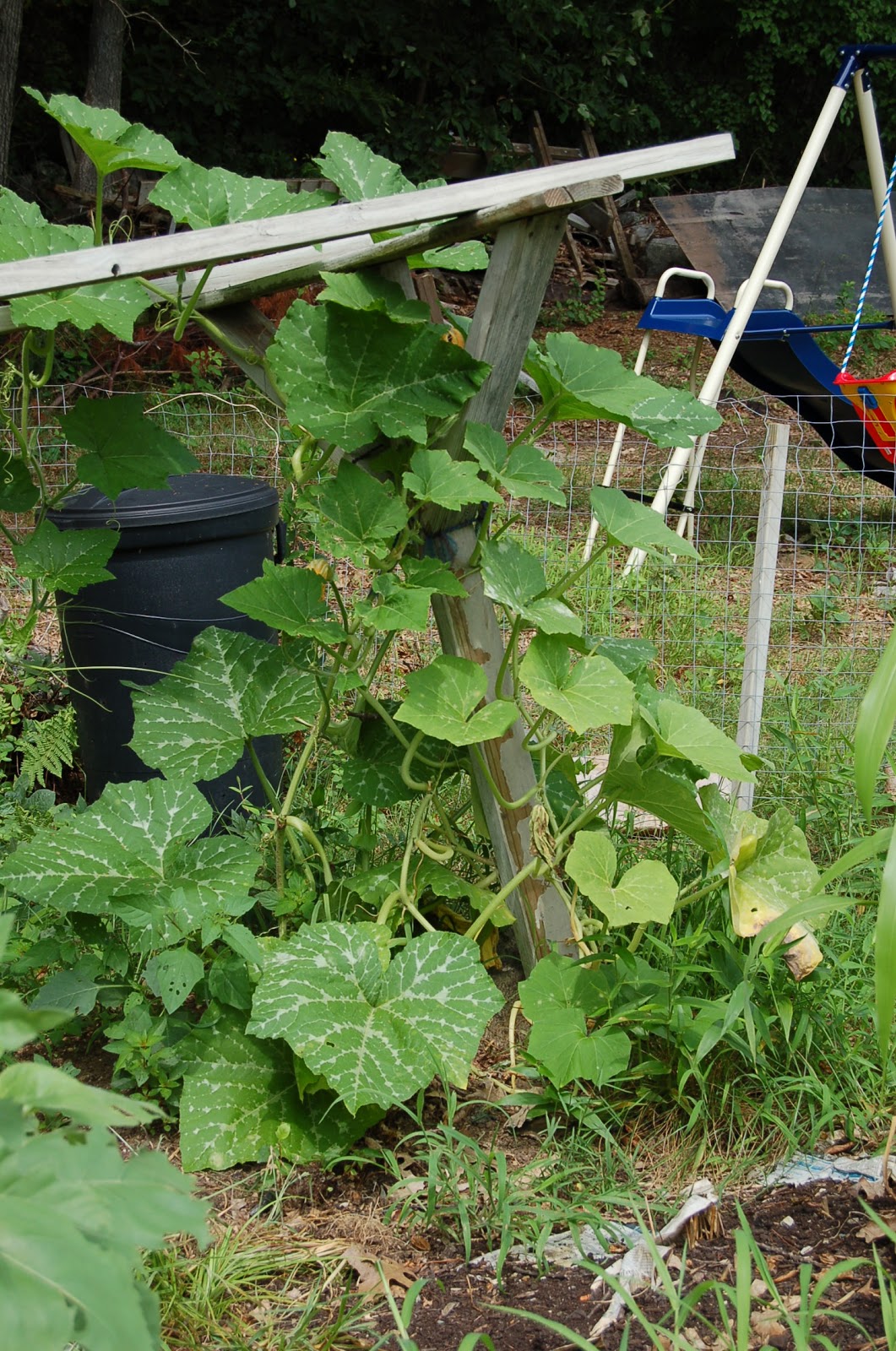
Zuchetta is a summer squash that vines and stores like a winter squash.  Rather than growing in a bush like most summer squashes, it is a vining plant grows up trellises and fences.  This may help in its vine borer resistance.  When you pick them, they have the soft skin of a summer squash, but the skin can harden so that they can be stored like a winter squash.  They apparently store so well that you can cut off one end and the cut piece will form a sort of seal so that the rest wont go bad.  The fruits can get up to three feet long and one plant can produce 20 squash.  I read that they taste similar to zucchini, but haven't been able to taste any just yet.  The vines themselves started fairly slow, but are beginning to take off quite quickly up my old grapevine arbor.  I did help them up it a little by tying them to it since there aren't any places for them to grab on the arbor.  I will post an update when I (hopefully) have some squash to show.

Tuesday, July 17, 2012

Structure for your compost pile


There must be a hundred different structures you can build to house your compost pile.  You can get from very simple like a pile with no structure all the way to a three bin rotation system or a large barrel mixer.  Some people go for the expensive fancy systems because they are nicer to look at or because they don't want to get too dirty.  Others don't care what they look like and even like to play in the dirt, so they go for the simpler no structure or simple structure type of a pile.  Sometimes, you need something more complicated if you have a lot that needs to be composted.  Currently, I have 2 composter types at my house.  A pile of leaves that sometimes has a wire cage around it and a garbage can with holes drilled into it for kitchen scraps.  Very simple, easy to build and easy to manage.
I like the pile because as I work I can just throw everything right there into the pile with no effort, rhyme or reason.  I do have to go back and mix it up as it composts, but not too much.  The wire cage helps to contain the pile somewhat so that it doesn't go everywhere or blow away.  It goes up when there starts to be too many leaves to keep in place in the fall.  When the cage is in my way, I just open it way up or take it down.  This usually means that I am mixing the pile or it's time to throw it on the garden.  Just about every time I have taken the cage down, it goes up in a totally new spot.  That is just one more reason why I like it being so simple.  I can change my mind as to where the best spot for it is whenever I need to.